Balancing Providence: The Johnstown Flood of 1889
In 1889, Johnstown, Pennsylvania, stood as a bustling steel mill and ironworks city near the Conemaugh River Valley and nestled in the Allegheny Mountains. Approximately fifteen miles away from the industrious, gritty city that served as home to 30,000 people, the South Fork Fishing and Hunting Club stood. South Fork Fishing and Hunting Club existed as a private club for the wealthy, elite, and prominent people. Influential members included Andrew Mellon, Andrew Carnegie, Henry Clay Frick, and Henry Phipps. They came from nearby Pittsburgh when seeking to escape city life. The Club centered around a man-made lake, Lake Conemaugh, with a poorly constructed and rarely maintained dam. Lake Conemaugh was three miles long and a little over one mile wide. The rich and the famous came to vacation and could not be bothered with the reports and rumors buzzing around the dam and its careless condition.
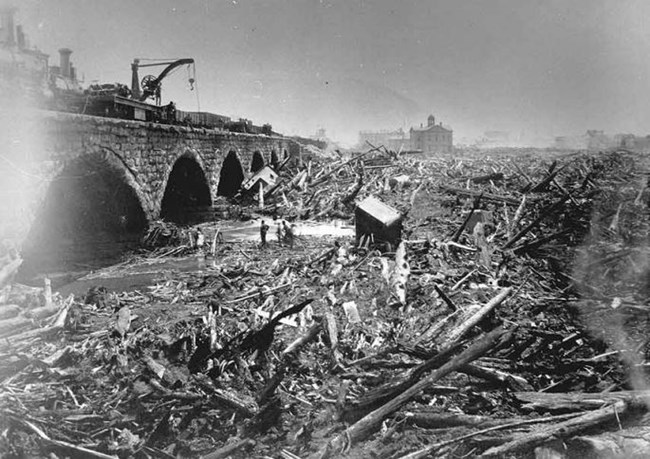
Everything changed for Johnstown on May 31, 1889, at approximately 3:15 PM, when the flimsy earthen dam, known as the South Fork Dam, collapsed after continuous storms plagued the region, sending a literal wall of water raging 15 miles away and swallowing the city of Johnstown, Pennsylvania. The entire lake, 20 million tons of water surged and raged over the dam, wiping out everything in its angry and destructive path. Locals ignored warnings previously sent earlier in the day; rumors spun for years that the dam could break “someday.” The vicious wave roared and raged for several minutes, ripping and tearing out homes, trees, and buildings – anything in its volatile path – and swept people and animals along with the debris. Entire blocks of the city yanked from their foundations, floating in the furious waters. Horrifying shrieks from the flood’s victims filled the air. The scene was terrifying. Bodies were strewn everywhere. Within forty minutes, the lake emptied. It only took ten minutes before Johnstown itself succumbed to utter devastation.

The worst was far from over, however. Despite the Stone Railroad Bridge near the south end of Johnstown remaining intact, nearly thirty acres of debris piled against it. Trees, fences, equipment, poles, houses (some with people trapped inside) slammed into a pile before igniting into unimaginable horror. Those who managed to survive being swept by the floodwaters faced certain death into the fiery hell. “Editor George Swank, who had been watching everything from his window at the Tribune office, wrote that the fire burned ‘with all the fury of the hell you read about – cremation alive in your own home, perhaps a mile from its foundation; dear ones slowly consumed before your eyes, and the same fate yours a moment later.”[1] The cause of the fire is not known but speculation points to a possible overturned stove.

The National Guard and the newly-created Red Cross, headed by Clara Barton, arrived to aid victims. With relief efforts also came the media. More than 2,200 people perished in the Johnstown Flood. The schoolhouse served as a makeshift morgue for the dead. Some victims were never recovered. The flood, argued by many at the time as an act of providence, was actually a terrifying man-made disaster. “The Johnstown Flood of 1889 devastated a community, tested the newly founded Red Cross, halted the operation of the Pennsylvania Railroad, and crippled one of the nation’s leading iron manufacturing companies.”[2] The South Fork Hunting and Fishing Club never faced criminal charges, and any lawsuits filed yielded no monies awarded to the victims or families. The juries maintained that the flood was an act of God. Historian David McCullough wrote, “So while there is no question that an ‘act of God (the storm of the night of May 30-31) brought on the disaster, there is also no question that it was, in the last analysis, mortal man who was truly to blame.”[3]
Source List:
McCullough, David G. The Johnstown Flood. New York, NY: Simon & Schuster Paperbacks, 2018.
Uldis Kaktins, Carrie Davis Todd, Stephanie Wojno, and Neil Coleman. “Revisiting the Timing and Events Leading to and Causing the Johnstown Flood of 1889.” Pennsylvania History: A Journal of Mid-Atlantic Studies 80, no. 3 (2013): 335–63.
Wharton-Michael, Patty. “The Johnstown Flood of 1889.” Journalism History. Spring 2012, Vol. 38, no. 1 (2012): 23–33.
“HUNDREDS LOST: JOHNSTOWN, PA., SWEPT AWAY BY A FLOOD. RIVER FULL OF BODIES THE MOST APPALLING CATASTROPHE OF MODERN TIMES.” The Washington Post (1877-1922), Jun 01, 1889. 1, http://ezproxy.liberty.edu/login?qurl=https%3A%2F%2Fwww.proquest.com%2Fhistorical-newspapers%2Fhundreds-lost%2Fdocview%2F138369960%2Fse-2%3Faccountid%3D12085.
“THOUSANDS WERE LOST: APPALLING REPORTS OF THE JOHNSTOWN DISASTER. OMINOUS SILENCE IN THE CONEMAUGH VALLEY. EIGHT TOWNS AND VILLAGES SWEPT AWAY–NO TELEGRAPH OR RAILROAD COMMUNICATION WITH THE DEVASTATED REGION–HUNDREDS OF BODIES BEARING WITNESS TO THE FLOOD’S TERRIBLE WORK.” New York Times (1857-1922), Jun 02, 1889. 1, http://ezproxy.liberty.edu/login?qurl=https%3A%2F%2Fwww.proquest.com%2Fhistorical-newspapers%2Fthousands-were-lost%2Fdocview%2F94719394%2Fse-2%3Faccountid%3D12085.
Citations:
[1] David G. McCullough. The Johnstown Flood. (New York, NY: Simon & Schuster Paperbacks, 2018). 149-150.
[2] Patty Wharton-Michael. “The Johnstown Flood of 1889.” Journalism History. Spring 2012, Vol. 38, no. 1 (2012): 23–33.
[3] David G. McCullough. The Johnstown Flood. (New York, NY: Simon & Schuster Paperbacks, 2018). 262.
 That History Lady