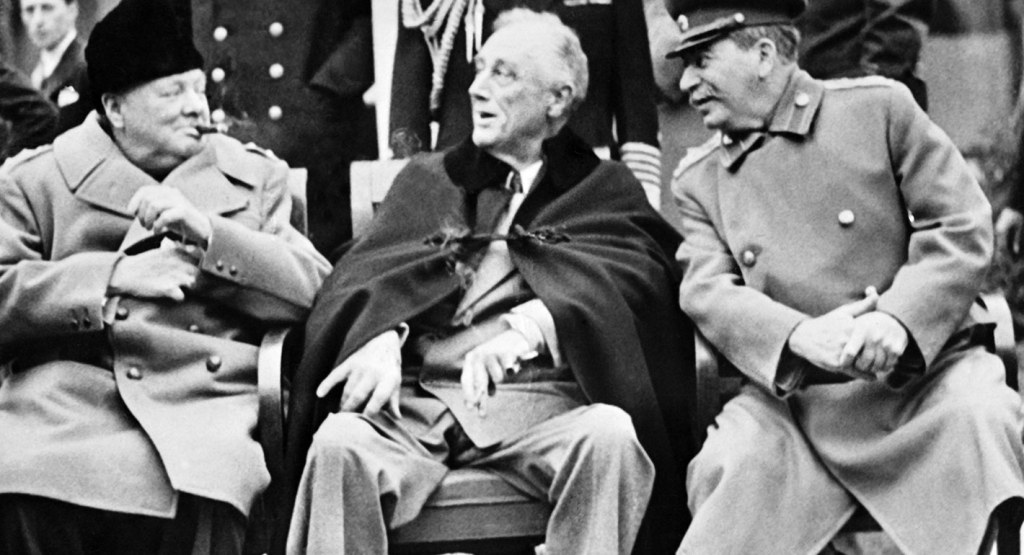
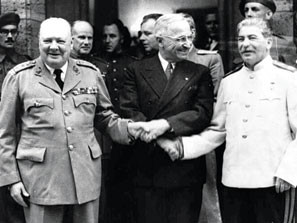
During World War II and immediately after that, the Soviet Union emerged in a much more favorable light globally. Their dedication to the defeat of Germany gave them a powerful presence as a legitimate, even respectable nation. (I think of the photographs from Yalta and Potsdam Conferences – Great Britain, the Soviet Union, and the United States all smiling politely for the cameras – diplomacy in action.) Once elevated as a founding member of the United Nations and member of the Security Council, the Soviets’ positive diplomatic persona allowed them to engage third-world countries seeking freedom from colonial rule. Additionally, they achieved more power, bought “friends,” and politely aggravated the United States and Western Europe. The Soviets exuded a newfound legitimacy in diplomatic circles, positioning themselves to gain tremendous influence around the globe. In discussing the defeat of Nazi Germany, Stalin said, “our victory signifies that our Soviet state system was victorious, that our multinational Soviet state passed all the tests of the war and proved its viability.”1 Conditions ripened for Communist exploitation and the Soviet Union basked in its arrogance and aggression.
As the Soviet Union expanded its presence, they did so cleverly enough to not attract too much attention from the United States and Great Britain. The Soviet Union permitted Bulgaria, Romania, and Hungary to appear more democratic. The Soviets were masters of diplomatic illusions. It also helped that the United States did not thwart the Soviet Union in some instances. “Throughout the summer and fall of 1945, officials in Washington understood that the Soviet Union was imposing police states in Bulgaria, Romania, and Poland, but they were unwilling to seriously confront the Soviets on the issue.”2

The Soviets also proved to be masters in the propaganda machine in scope and size. They marketed themselves as friends to oppressed and downtrodden nations, acted as the breaker of chains to third-world countries burdened by colonialism. In that same speech, Stalin also said, “Now the issue is that the Soviet State system has proved to be a model multinational state, that the Soviet state system is a system of state organization in which the national problem and the problem, of the collaboration of nations have found a better solution than in any other multinational state.”3 They hid the brutality and savagery that lurked within Communism, aligning their messages as though it could be propaganda from the free world. Once infiltrated and in control, the Soviets placed tremendous restrictions and implemented extreme censorship. Communism was the only way; it would be all that their new friends would know. Without question, Stalin and his regime knew how to propagandize internally as well as externally, gaining support and devotion.
With the defeat of Nazi Germany, the world got to see just how impressive the Soviet military was. According to Stalin, “our victory signifies that the Soviet Armed Forces, our Red Army, was victorious, that the Red Army heroically withstood all the hardships of the war, utterly routed the armies of our enemies, and emerged from the war the victor.”4 Stalin and the Soviets knew the army they had would not be enough for his future plans. The Soviets desired a bigger, stronger army. The revamped Red Army needed to be braver, even more brutal, and unapologetically ruthless. Stalin said, “But bravery alone is not enough to overpower an enemy who possesses a vast army, first-class armaments, well-trained officers and fairly well-organized supplies.”5 They built from within and offered aid and military support to their new “friends.”
Nothing came for free. Soviet gifts always came with strings attached, and Soviets were determined to make sure their new friends became utterly dependent upon the Soviet Union for safety and supplies. Additionally, the Soviets had created a massive and successful network of espionage. Subversion and sabotage ran rampant with the Soviets. Most importantly, the Soviets spent a great deal of time learning and acquiring nuclear power.

The Soviet Union, once considered a backward agricultural nation, quickly advanced as an industrial power, exemplifying an industrial success story. As mentioned above, the Soviets proved to be quite generous, seducing potential conquests with aid, military, and improvements to living conditions. According to Stalin, “This unprecedented growth of production cannot be regarded as the simple and ordinary development of a country from backwardness to progress.”6 Stalin went on to boast of how success and growth take much longer in capitalist societies, but in Communism, they were far superior and successful, resulting in faster success. According to Stalin, “It was greatly facilitated by the nationalization of industry and the banks, which made it possible quickly to collect funds and transfer them to heavy industry.” The establishment of trade bloc proved successful for the Soviet Union as did their ability to give to allies while denying to enemies.”
Communism was never about what was good for the Russian people (or any people under Communist rule.) It was about totalitarianism, complete control. At times, the Soviets aggressively infiltrated a nation; other times, they implemented a friendlier, less obvious approach. Forty-four years of fear, violence, and control dominated throughout the Soviet Union. The Soviets were undoubtedly outstanding puppet masters when it came to diplomacy, ideology, military, and economic instruments of power. Their festering aggression enabled them to create a genuinely bipolar world, striking fear in nations around the world – a fear that haunted the globe for over four decades.
Footnotes:
1 Stalin, Joseph. “Speech Delivered by Stalin at a Meeting of Voters of the Stalin Electoral District, Moscow.” February 9, 1946. Wilson Center Digital Archive. Accessed December 14, 2020. https://digitalarchive.wilsoncenter.org/document/116179.
2 Paul C. Avey. “Confronting Soviet Power: U.S. Policy during the Early Cold War.” International Security 36, no. 4 (2012): 170.
3 Ibid, Stalin.
4 Ibid, Stalin.
5 Ibid, Stalin.
6 Ibid, Stalin.
Bibliography:
Ackermann, Felix, and Sören Urbansky. “Einleitung — Introduction: Reframing Postwar Sovietization: Power, Conflict, and Accommodation.” Jahrbücher Für Geschichte Osteuropas, Neue Folge, 64, no. 3 (2016): 353-62.
Avey, Paul C. “Confronting Soviet Power: U.S. Policy during the Early Cold War.” International Security 36, no. 4 (2012): 151-88.
“Potsdam Conference July 17-August 2, 1945.” Protocol of the Proceedings, August l, 1945 https://avalon.law.yale.edu/20th_century/decade17.asp
Roberts, Geoffrey. “Moscow’s Cold War on the Periphery: Soviet Policy in Greece, Iran, and Turkey, 1943–8.” Journal of Contemporary History 46, no. 1 (2011): 58-81.
Shearer, David. “Stalin at War, 1918-1953: Patterns of Violence and Foreign Threat.” Jahrbücher Für Geschichte Osteuropas, Neue Folge, 66, no. 2 (2018): 188-217.
Stalin, Joseph. “Speech Delivered by Stalin at a Meeting of Voters of the Stalin Electoral District, Moscow.” February 9, 1946. Wilson Center Digital Archive. Accessed December 14, 2020. https://digitalarchive.wilsoncenter.org/document/116179.
“Yalta Conference Agreement, Declaration of a Liberated Europe,” February 11, 1945, History and Public Policy Program Digital Archive, National Archives. https://digitalarchive.wilsoncenter.org/document/116176
 That History Lady