Religion played a significant role in many Civil War military leaders, especially Thomas J. “Stonewall” Jackson. Significant writing exists detailing his devoutness and dedication to faith and religion, especially during the Civil War. Jackson clung to his unwavering commitment to Christianity throughout his time in the war. He openly prayed and read and quoted scripture and held tightly to his faith no matter the circumstances he faced. He applied that strong faith in his command. William J. Jones served as a chaplain to the Army of Northern Virginia and spoke highly of Jackson’s faith. He described Jackson in vivid detail, “He was frequently observed in the beginning and in the midst of the battle to lift up his hands towards heaven, and those near could hear his ejaculatory prayers.”[1]
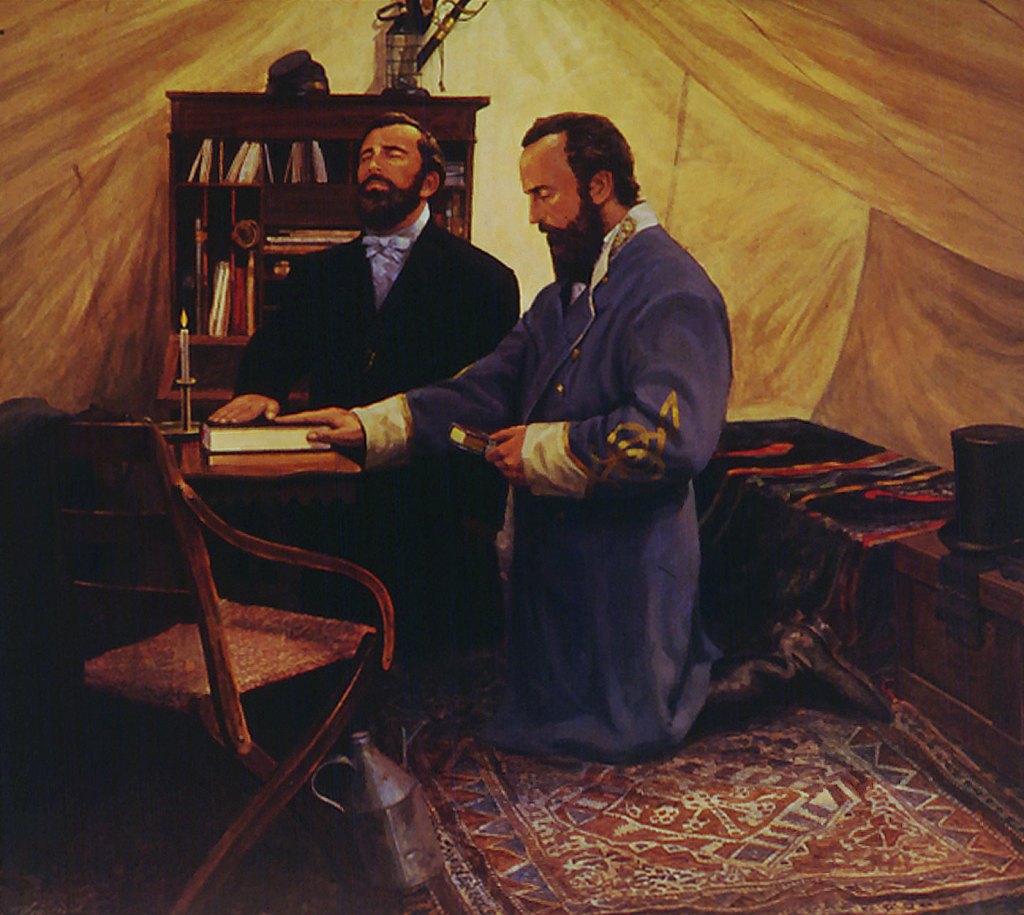
Shortly after the Confederate victory at First Manassas, Jackson penned a letter to his wife, wherein Jackson spoke of the victory of the Confederates. Stonewall Jackson took no glory for himself. He stated, “My preservation was entirely due, as was the glorious victory, to our God, to whom be all the honor, praise, and glory. The battle was the hardest that I have ever been in, but not near so hot in its fire. I commanded the centre more particularly, though one of my regiments extended to the right for some distance. There were other commanders on my right and left. Whilst great credit is due to other parts of our gallant army, God made my brigade more instrumental than any other in repulsing the main attack.”[2]

War and battle did not follow a schedule, and sometimes fighting occurred on the Sabbath, much to the dismay of Stonewall Jackson. However, while he was not a fan of it, Stonewall Jackson understood the necessity of fighting on Sunday. After all, desperate times often call for desperate measures. Dr. Steven E. Woodworth explained, “The Bible clearly allows for necessary labor on the Sabbath, but for an army in wartime, that could be a fairly broad loophole. Even the sincerely pious Thomas J. Stonewall Jackson sometimes felt that it was necessary, as for example, at the battle of Kernstown, in March 1862, to attack the enemy on Sunday.”[3] An interesting side note must be mentioned here. On November 15, 1862, President Abraham Lincoln issued “The Sunday Rest Order” to prompt the enactment of stricter Sunday observance among the troops. The order states, in part, “The President, Commander-in-chief of the Army and Navy, desires and enjoins the orderly observance of the Sabbath by the officers and men in the military and naval service. The importance for man and beast of the prescribed weekly rest, the sacred rights of Christian soldiers and sailors, a becoming deference to the best sentiments of a Christian people, and a due regard for the Divine Will, demand that Sunday labor in the army and navy be reduced to the measure of strict necessity.”[4]

During the second day of the battle of Chancellorsville, May 2, 1863, Stonewall Jackson suffered a devastating injury. In the darkness and confusion of the wildness, near the Rapidan River, three bullets struck Stonewall Jackson. Captain Richard Eggleston Wilbourn, who tended to Jackson while awaiting safe transport away from the battle and to a surgeon, wrote that when expressing disbelief at the situation, Jackson commented, “Yes, it is providential.”[5] Despite surviving the wounds, Stonewall Jackson became ill a few days later, and, on Sunday, May 10, 1863, Jackson died. He was 39-years-old. Jackson found peace and comfort as he struggled with pneumonia, knowing that it was all part of God’s plan. “I can wait until God, in His own time, shall make known to me the object He has in thus afflicting me. But why should I not rather rejoice in it as a blessing, and not look on it as a calamity at all? If it were in my power to replace my arm, I would not dare to do it, unless I could know it was the will of my Heavenly Father.”[6]

Through it all, Jackson never wavered in his faith. The day before Stonewall Jackson passed, his wife, Mary Anna, spoke in her memoirs of wanting to read Psalms to him as he was in distress. She believed it would help soothe and comfort him. At first, he declined, indicating he was suffering too much to listen, but he quickly replied, “Yes, we must never refuse that. Get the Bible and read then.”[7] General Thomas J. “Stonewall” Jackson succumbed to his illness the next day. Even as he knew the end was near, he found comfort in dying on the Lord’s Day. It seems so fitting for a man so pious and dedicated to his faith.

Bibliography:
Jackson, Mary Anna. Life and Letters of General Thomas J. Jackson. New York, NY: Harper and Bros, 1891.
Jackson, Thomas J. “The Credit Goes to God.” —July 23, 1861.” The Routledge Sourcebook of Religion and the American Civil War, edited by Robert R. Mathisen. Routledge, 2014. http://ezproxy.liberty.edu/login?url=https://search.credoreference.com/content/entry/routsracw/the_credit_goes_to_god_july_23_1861/0?institutionId=5072
Jones, J. William. “His Christian Character is Well Worthy of Earnest Study” —May 1863.” The Routledge Sourcebook of Religion and the American Civil War, edited by Robert R. Mathisen. Routledge, 2014. http://ezproxy.liberty.edu/login?url=https://search.credoreference.com/content/entry/routsracw/his_christian_character_is_well_worthy_of_earnest_study_may_1863/0?institutionId=5072
Lincoln, Abraham. “The Sunday rest Order” —November 15, 1862.” The Routledge Sourcebook of Religion and the American Civil War, edited by Robert R. Mathisen. Routledge, 2014. http://ezproxy.liberty.edu/login?url=https://search.credoreference.com/content/entry/routsracw/the_sunday_rest_order_november_15_1862/0?institutionId=5072
Wilbourn, Richard Eggleston. “An Eyewitness Account of Stonewall Jackson’s Wounding.” Virginia Museum of History & Culture. Virginia Museum of History & Culture. Accessed May 2, 2022. https://virginiahistory.org/learn/historical-book/chapter/eyewitness-account-stonewall-jacksons-wounding.
Woodworth, Steven E. While God Is Marching On: The Religious World of Civil War Soldiers. Lawrence, KS: University Press of Kansas, 2003.
[1] William J. Jones. “His Christian Character is Well Worthy of Earnest Study” —May 1863.” The Routledge Sourcebook of Religion and the American Civil War, edited by Robert R. Mathisen. Routledge, 2014. http://ezproxy.liberty.edu/login?url=https://search.credoreference.com/content/entry/routsracw/his_christian_character_is_well_worthy_of_earnest_study_may_1863/0?institutionId=5072
[2] Thomas J. Jackson. “The Credit Goes to God. —July 23, 1861.” The Routledge Sourcebook of Religion and the American Civil War, edited by Robert R. Mathisen. Routledge, 2014. http://ezproxy.liberty.edu/login?url=https://search.credoreference.com/content/entry/routsracw/the_credit_goes_to_god_july_23_1861/0?institutionId=5072
[3] Steven E. Woodworth. “While God is Marching On: The Religious World of Civil War Soldiers.” (Lawrence, KS: University Press of Kansas, 2001). 83.
[4] Abraham Lincoln. “The Sunday rest Order” —November 15, 1862.” The Routledge Sourcebook of Religion and the American Civil War, edited by Robert R. Mathisen. Routledge, 2014. http://ezproxy.liberty.edu/login?url=https://search.credoreference.com/content/entry/routsracw/the_sunday_rest_order_november_15_1862/0?institutionId=5072
[5] Richard Eggleston Wilbourn. “An Eyewitness Account of Stonewall Jackson’s Wounding.” Virginia Museum of History & Culture. Virginia Museum of History & Culture. Accessed May 2, 2022. https://virginiahistory.org/learn/historical-book/chapter/eyewitness-account-stonewall-jacksons-wounding.
[6] Mary Anna Jackson. Life and Letters of General Thomas J. Jackson. (New York, NY: Harper and Bros, 1891). 292-3.
[7] Ibid, 299.
 That History Lady