The Great Awakening as a Unifier Towards Freedom
When the first settlers arrived in America, they clung tightly to their faith. Religion played a major role in their lives and their government structure. At some point, however, the passion for religion began dwindling. People felt restless, and they felt a sense of loss for a true, personal connection as the rigidity of religion, church services, and worship became too stuffy and formal and, in some cases, institutionalized. Enter the First Great Awakening — a religious revival movement that inspired enthusiasm and reignited the religious spark in the colonies. A series of revivals invigorated, revamped, and renewed people’s passion for religion – a movement invoking the Holy Spirit to rain down and infuse the people, uniting them. Christianity, across all denominations, felt the powerful impact of these revivals. Charismatic evangelical preachers such as George Whitefield sought to gather the masses and replenish the people with the word of God and infuse their souls again.
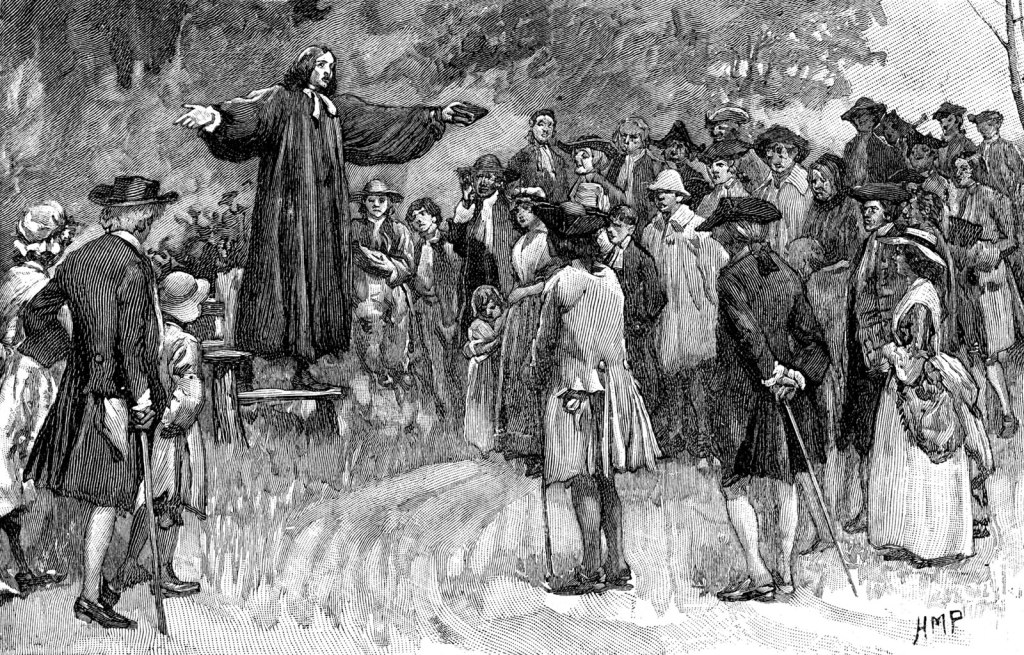
The First Great Awakening inspired the rebellion in a sense as the powerful thrust towards religious freedom became essential. The Great Awakening impacted independence, autonomy, and freedom. FREEDOM AND LIBERTY echoed throughout the experiences of the First Great Awakening. Colonists grasped the biblical lessons thereby justifying resistance and rebellion, intertwining religion and politics. The sermons of Samuel Davies hugely impacted Patrick Henry. Anglican Minister, George Whitefield, often referred to as the “Forgotten Founding Father” and the “Accidental Revolutionary,” forged a strong friendship with Benjamin Franklin
The Great Awakening was universal — the south, the north, and the middle colonies were all touched by this trans-denominational movement. It created colonial networks and trans-colonial events, uniting people of different colonies and different religious backgrounds.
From the moment Whitefield arrived in the colonies, he transcended geography and religious denominations and gender, social status, and racial divisions. For the first time, thirteen extraordinarily diverse colonies aligned as one nation as they embraced the Great Awakening. From this unification evolved a solid and committed country ready to challenge England’s tyranny and declare its independence. “However shocking it is in this world, all the differences that have been among the people of God, will only make us sing and unite us better in a future state.”
One final, albeit potentially rambling, thought: it is fascinating that so many people today take issue or offense to our government, our Constitution having Christian roots and influence. The Bible deeply influenced the earliest settlers in their government as well as their culture. The Bible was pretty much all they had; and, every aspect of their lives, their existence found its roots in the Bible. Consider during the early days of America that the Bible was THE very foundation for social, legal, and family norms and the people applied the Bible in their daily lives. No matter what religion the people practiced, religion was essential to them. These people lacked the droning distractions of media, social media, and the entertainment industry. And, as history repeatedly shows, when society falls away or turns away from these religious principles, disaster happens; society then plunges into very dark, evil events and experiences.
Citation:
Whitefield, George, Joseph Gurney, and Andrew Gifford. Eighteen Sermons Preached by the Late Rev. George Whitefield. Printed at Newburyport: by Edmund M. Blunt, 1797. Sabin Americana: History of the Americas, 1500-1926 https://link.gale.com/apps/doc/CY0100537878/SABN?u=vic_liberty&sid=bookmark-SABN&xid=fb1076d8&pg=302.
 That History Lady
The above article is such a great example of how the daily struggle of survival in the early days of American settlers can translate on a similar level to current American life and the daily stress of work and home life. It shows how a basic survival instinct is to look for hope and to spread joy as a way to make the hardest days worth living for ourselves and others through religious gatherings.
LikeLike